
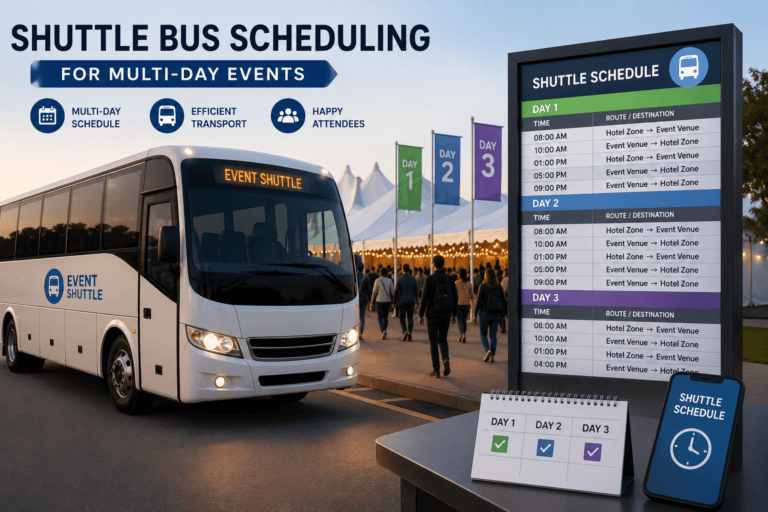
A one-day event only has to get its transport schedule right once. A multi-day event has to get it right repeatedly, under slightly different conditions each time, and that’s exactly where most shuttle scheduling mistakes come from. The plan that worked perfectly on day one quietly starts breaking down by day two or three, usually for reasons that were predictable in advance.
Why Is Multi-Day Shuttle Scheduling So Different From a One-Day Event?
A single-day event has one set of numbers to plan around: one start time, one end time, one expected headcount. A multi-day event has several sets of those numbers stacked on top of each other, and treating them as one continuous block rather than several distinct days is where the plan usually starts to drift.
Small mismatches that wouldn’t matter on a single day tend to compound instead. A shuttle schedule that’s five minutes off on day one is a minor inconvenience. The same five-minute gap, repeated and slightly worse each day because nobody adjusted it, becomes a real problem by the final session.
What’s the Most Common Scheduling Mistake Organisers Make?
Copying the first day’s schedule across every remaining day is the single most common error, and it’s understandable why it happens. Building a shuttle schedule takes real effort, and once day one is planned, reusing it for the rest of the event feels efficient rather than risky.
The problem is that attendance rarely stays flat across a multi-day event. Opening keynotes and headline sessions typically draw a full crowd, while later days or half-day closing sessions often see noticeably fewer attendees. A shuttle schedule built for day one’s numbers ends up running near-empty by the final day, or worse, understaffed if a specific afternoon session unexpectedly draws a bigger crowd than the organisers planned for.
How Should Fluctuating Daily Attendance Actually Be Handled?
The fix is treating each day as its own forecast rather than one flat estimate applied across the whole event. That means asking, day by day, how many attendees are actually expected at each session, rather than assuming the opening day’s headcount holds steady throughout.
This is also where bus size matters more than people expect. A single bus size locked in for the entire event is convenient to book but rarely matches the reality of shifting numbers across different days. Reviewing our types of buses before finalising a multi-day schedule makes it easier to match capacity to each day’s actual expected headcount, rather than over-committing to one size for days that don’t need it and under-committing on the days that do.
What Happens When Venues or Timings Change Mid-Event?
Multi-day events rarely run identically from start to finish. A conference might run at one venue for the main sessions and shift to a separate location for an evening dinner or closing reception. End times shift too, with a full first day often followed by a shorter half-day close, and a static schedule that assumes every day looks the same struggles to absorb either kind of change.
Building day-specific routes and timings, rather than one template copied across the whole event, is what actually holds up here. It takes more planning upfront, but it’s considerably less disruptive than discovering on day two that the shuttle schedule doesn’t match where or when people actually need to be picked up.
Why Does Communication Break Down Between Organisers and the Transport Provider Mid-Event?
A lot of scheduling problems don’t actually show up in the planning stage. They surface once the event is already running, when a session overruns, a speaker changes the agenda on the day, or attendance on a particular afternoon looks nothing like what was forecast. A transport plan that was only discussed once before day one has no way to adapt to any of that.
Having a single point of contact reachable throughout the event, not just during initial planning, is what actually catches these issues before they become a missed pickup or a bus sitting half-empty at the wrong time. Multi-day events benefit from ongoing coordination in a way that single-day events usually don’t need.
What Actually Prevents These Mistakes?
In practice, three things separate a multi-day shuttle plan that holds up from one that doesn’t. Each day gets reviewed and adjusted on its own terms rather than inheriting the previous day’s schedule by default. Timing between sessions and shuttle departures includes real buffer rather than being planned back-to-back, since event schedules shift more often than transport schedules assume. And there’s a contact available throughout the event itself, not only in the planning stages beforehand.
For a corporate conference or multi-day event, this kind of day-by-day planning is usually the difference between transport that quietly works in the background and transport that becomes something organisers have to keep managing on top of everything else.
If you’re planning shuttle logistics for a multi-day event, get in touch with our shuttle bus service and walk us through the day-by-day agenda rather than just the overall dates. We’ll help you plan around the days that actually differ, instead of assuming one schedule fits all of them.