
For businesses with large teams, multiple shifts or offices located away from major transport routes, getting employees to and from work can become a daily operational challenge. Late arrivals, long commutes and complicated travel arrangements can affect both employee experience and workplace efficiency.
An employee shuttle bus service in Singapore can provide a structured solution by giving staff scheduled transportation between designated pickup points and the workplace.
But arranging a reliable shuttle is about more than simply hiring a bus. The route, schedule, passenger numbers, vehicle size and shift patterns all need to work together.
What Is an Employee Shuttle Bus Service?
An employee shuttle bus is a pre-arranged transport service designed to move employees between selected pickup points and a workplace.
Unlike a one-off bus charter for an event, staff transportation is often based on a repeating schedule.
For example:
Residential pickup points → workplace → return journey
A company may operate one morning and evening route, or several routes depending on where employees live and when different shifts begin and end.
RL Transport provides shuttle and corporate bus services for staff transport, with routes and schedules that can be adapted to different business requirements.
When Should a Company Consider Staff Transport?
Not every business needs an employee shuttle. It becomes particularly useful when employees face recurring transportation challenges.
A company may consider staff transport when:
- Employees work in industrial or business areas
- Staff start or finish outside normal commuting hours
- Employees are spread across different parts of Singapore
- Parking at the workplace is limited
- Public transport does not align well with shift times
- A large number of employees travel to the same location
- The company wants a more structured commuting arrangement
For businesses operating night shifts, dedicated transport can be particularly useful because public transport options may be more limited during late hours. RL Transport already provides late-night transportation for night-shift employees, hospitality teams and industrial operations.
How to Plan an Employee Shuttle Route
Route planning is one of the most important parts of an employee shuttle service.
Start by identifying where employees actually live, rather than choosing pickup points based only on convenience for the company.
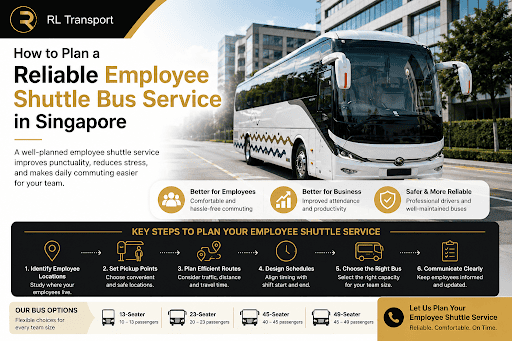
Step 1: Identify employee clusters
Group employees according to their general residential areas.
For example, if many employees live around several nearby neighbourhoods, they may be served by one route instead of multiple individual pickups.
Step 2: Choose practical pickup points
A pickup point should be easy for employees to reach and suitable for the bus to stop safely.
Too many stops can increase journey time, so the goal is to find a balance between accessibility and efficiency.
Step 3: Consider traffic conditions
Singapore’s traffic conditions can vary considerably during peak periods.
A route that looks efficient on a map may take significantly longer during morning or evening peaks.
Allowing reasonable journey buffers can help reduce the impact of unexpected delays.
Step 4: Work backwards from shift times
If employees need to be at work at 8:00 a.m., the bus schedule should not simply be based on the estimated driving time.
Allow time for:
- Multiple pickups
- Traffic
- Passenger boarding
- Unexpected delays
- Final arrival
The same principle applies to return journeys.
How Many Employees Can One Shuttle Bus Carry?
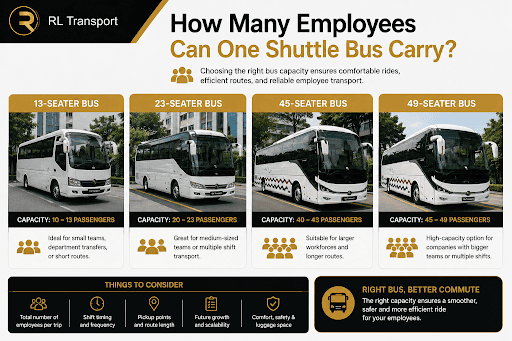
Vehicle capacity should match both the number of passengers and the frequency of the service.
RL Transport currently lists several vehicle options, including:
| Bus | Approximate capacity | Typical use |
| 13-seater | 10–13 passengers | Smaller teams |
| 23-seater | 20–23 passengers | Medium-sized staff groups |
| 45-seater | 40–45 passengers | Larger workforce transport |
| 49-seater | 45–49 passengers | High-capacity group transport |
A company should not automatically choose the largest bus available. If employee demand is relatively small, a smaller vehicle may provide a more practical solution.
Conversely, if several shifts overlap, multiple vehicles or larger-capacity buses may be necessary.
Managing Different Employee Shifts
Shift patterns can make employee transportation more complicated.
A manufacturing facility, hotel, warehouse or other 24-hour operation may have:
- Morning shifts
- Afternoon shifts
- Evening shifts
- Overnight shifts
- Weekend shifts
A single shuttle timetable may not work for everyone.
Instead, companies can develop shift-aligned schedules, with separate departure times or routes where necessary.
RL Transport’s late-night service specifically supports businesses with night-shift employees and offers scheduled transport, multiple drop-off points and routes designed around shift changes.
Employee Shuttle vs Individual Travel
Companies should also consider how employee transportation is currently being managed.
Without a coordinated shuttle, employees may rely on a combination of:
- Public transport
- Taxis
- Ride-hailing
- Private vehicles
- Travel reimbursements
This can make commuting arrangements difficult to manage, particularly when employees have different schedules.
A dedicated shuttle provides a more structured alternative where a sufficient number of employees share similar routes and working hours.
The goal should not simply be to replace every employee’s existing commute. Instead, companies should identify where shared transport provides the greatest operational value.
How to Make Employee Shuttle Services More Reliable
Once the route is established, consistency becomes important.
Consider the following:
Keep pickup points simple
Too many stops can make the journey unnecessarily long.
Communicate schedules clearly
Employees should know where to board, when the bus arrives and what to do if they miss it.
Build reasonable time buffers
Allowing some flexibility can make the service more resilient to traffic delays.
Review routes regularly
Employee locations and shift patterns can change. A route that worked well six months ago may need adjustment.
Plan for peak periods
Public holidays, major events and unusual traffic conditions can affect journey times, so advance planning is important.
What Should You Ask a Shuttle Bus Provider?
Before choosing an employee transport service in Singapore, ask about:
- Available vehicle sizes
- Driver licensing and experience
- Vehicle maintenance
- Insurance
- Route flexibility
- Pickup and drop-off arrangements
- Shift-based scheduling
- Multiple routes
- Long-term arrangements
- Backup options
- Pricing structure
RL Transport states that its fleet is insured and LTA-compliant, with licensed drivers and island-wide coverage.
It also offers multiple bus sizes, allowing companies to select vehicles according to group requirements.
Final Thoughts
A reliable employee shuttle bus service should be planned around people, routes and working hours, not simply the number of seats available.
Start by understanding where employees live, when they need to arrive, when they finish work and how many people require transportation at each time.
From there, a suitable route, vehicle and schedule can be developed.
For businesses with recurring staff transport requirements, a well-planned shuttle can provide a more structured way to manage employee commuting—particularly for companies with shift workers, dispersed teams or workplaces that are less convenient to reach by public transport.
RL Transport provides corporate bus charter and shuttle transportation in Singapore, with vehicle options ranging from smaller 13-seater vehicles to larger 49-seater coaches.
The best employee transport plan isn’t necessarily the one with the biggest bus. It’s the one that matches your workforce, routes and operating schedule.