
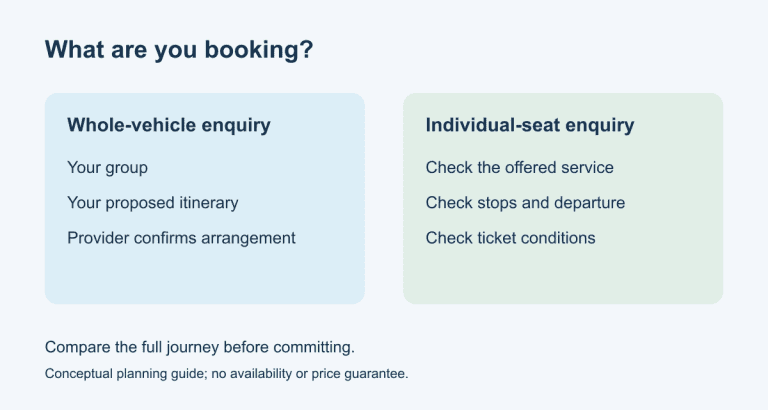
Are you booking transport for your group, or buying individual places on an existing service? That is the useful starting point for the charter bus vs bus ticket decision. A private charter enquiry concerns the whole vehicle and an agreed group itinerary. Individual-seat travel concerns each passenger’s place on a service whose route, departure and booking conditions must suit the journey.
If your group needs a shared pickup, particular stops and a coordinated return, ask about a charter. If passengers can travel independently and an existing service fits their plans, investigate individual-seat options with the relevant operator. Neither arrangement is automatically cheaper or more suitable. Compare the actual journey, confirmed availability and complete terms.
RL Transport’s supplied material describes private bus charter and group transport services. It does not establish that RL sells individual scheduled bus tickets. This guide explains which enquiry to make; it does not report booking trends or claim that one option is what most organisers buy.
First establish what you are reserving
RL Transport’s private bus service page defines a private charter as renting the whole vehicle for your group. That distinction matters more than the word used in a search result. You are discussing a transport arrangement around your passengers, route and timing, rather than assuming that a ticket purchase reserves a vehicle exclusively for you.
For an individual-seat service, check what the booking actually includes. Is it a named departure? Where do passengers board? Does the service reach the destination you need, or will everyone require an onward journey? These are questions for the ticket operator. The supplied evidence does not identify a particular scheduled service, its fares or its ticket conditions.
Do not let the word “rental” create another assumption. RL’s guide to bus charter and bus rental arrangements explains that providers use these terms differently. Confirm the driver, vehicle, itinerary, service duration and inclusions. A label alone does not tell you precisely what you are buying.
Compare the complete journey, not just the booking label
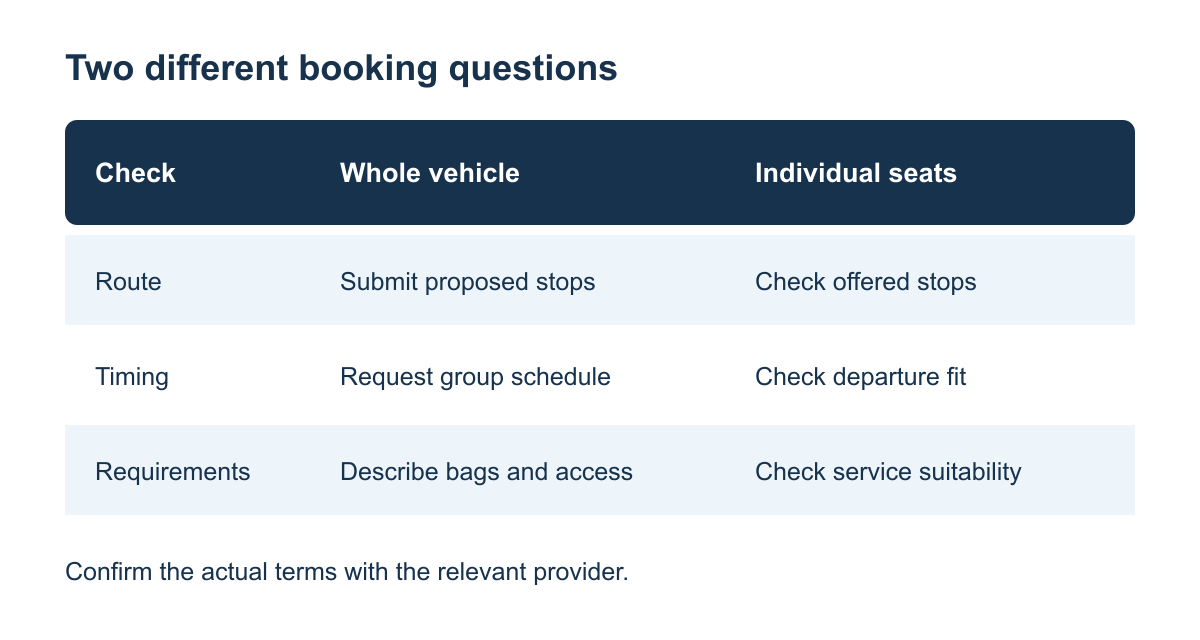
Use this table before requesting prices. It separates the decisions you can prepare from the details each provider must confirm. It is a planning checklist, not a statement that every charter or ticket service has identical conditions.
| Decision | Whole-vehicle charter enquiry | Individual-seat enquiry |
|---|---|---|
| What is being booked? | A vehicle arrangement for your group and agreed itinerary. | Confirm the individual place, journey and departure covered by each booking. |
| Pickup and destination | Submit exact locations and ask whether the proposed stops can be served. | Check boarding and alighting points, plus any onward travel. |
| Timing | Request pickup, required arrival and return timings. | Check the offered departure against each passenger’s schedule. |
| Travelling together | Ask the provider to match the vehicle to the complete group. | Check availability for the party and any seating arrangements that matter. |
| Luggage and access | Describe bags, equipment and access requirements before vehicle selection. | Check the selected service’s luggage and accessibility arrangements. |
| Price comparison | Obtain a quotation for the full itinerary and confirm inclusions. | Obtain the relevant fares and include any connecting journeys in your comparison. |
| Changes | Ask about amendments to stops, timings and passenger numbers. | Check the operator’s change and cancellation conditions. |
When a shared itinerary makes charter worth enquiring about
Start with the part of the day that cannot move. For an event, that might be the required arrival time. Work backwards to identify where passengers can gather and whether they need to travel together. A charter enquiry is useful when the transport plan needs to follow those requirements, subject to the provider accepting the route and timing.
Consider a group attending an event and returning from the same venue. The organiser needs more than an outward departure: the enquiry should include the return pickup point, expected finish and whether waiting is required. RL’s supplied guides identify return journeys, multiple stops and waiting time as matters to discuss. None should be treated as automatically included.
A different group may start from separate locations and leave at different times. Before gathering everyone for a charter, ask whether a shared departure actually helps them. If an existing individual-seat service fits, compare that complete journey. The practical test is whether a common itinerary solves a real coordination problem, rather than creating an unnecessary meeting point.
Count passengers, then describe what travels with them
A passenger total is essential, but it is not a complete vehicle brief. RL’s material specifically advises considering luggage, mobility requirements and equipment alongside group size. Send the provider both the number travelling and a description of what they will bring. Ask for a suitable seated arrangement; do not plan around standing passengers.
For an airport transfer, distinguish passenger bags from any larger items. For an event, mention equipment or materials as well as personal belongings. Do not infer storage capacity from a vehicle’s name or seat count. Ask how the proposed vehicle accommodates the actual load and whether that affects the recommended arrangement.
Accessibility needs require the same specificity. Explain the boarding assistance or access arrangement passengers need and ask the provider to confirm suitability before booking. The source material invites special requests; it does not prove that every vehicle can meet them. Avoid telling passengers that access is available until the particular arrangement has been confirmed.
Request a price for the trip you will actually take
There is no evidence here for a universal break-even point between charter and individual tickets. RL’s guides identify vehicle size, route, duration, stops, timing and special requirements as quotation factors. A headline ticket fare and an incomplete charter estimate do not answer the organiser’s real budget question.
Put the same outward and return journey into both comparisons. For the charter, ask whether parking, tolls, waiting and any late-night surcharge are included or additional. For individual-seat travel, check the actual fare conditions and any separate connections needed to reach the meeting point or venue. Do not assume a return is included in either option.
If you divide a charter quotation among participants, treat that as your budgeting calculation. It does not turn the arrangement into a scheduled ticket service or mean RL is selling individual seats. If attendance changes, revisit both the amount participants contribute and the vehicle requirements with the provider. Confirm amendment terms before collecting commitments from the group.
Turn your decision into a usable enquiry
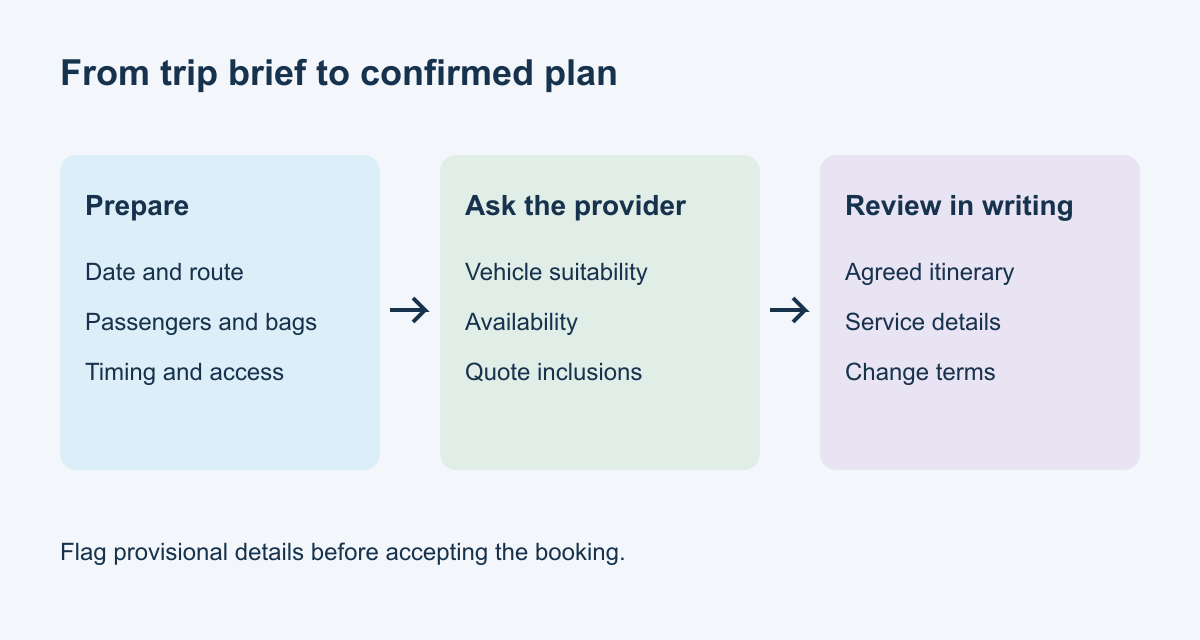
RL’s bus charter booking guide asks organisers to prepare their date, pickup and drop-off details, passenger count, timing and trip type. Its useful lesson is to send the whole journey together. An omitted return leg or extra pickup can leave the quotation addressing a different trip from the one you intend.
Write the stops in travel order. Separate the requested pickup time from the required arrival time, then state the expected finish. Flag anything still provisional. That lets the provider distinguish a confirmed requirement from a planning assumption without guessing which details matter most.
| Send with your enquiry | Question to resolve |
|---|---|
| Travel date and full route | Can you accommodate these locations in this order? |
| Pickup and required arrival times | What schedule do you propose for this itinerary? |
| Passenger count | Which vehicle arrangement seats everyone? |
| Bags and equipment | Can the proposed vehicle accommodate these items? |
| Access requirements | What suitable arrangement can you confirm? |
| Return or waiting requirements | What service period and charges does the quotation cover? |
| Provisional details | What happens if these change before travel? |
Check availability and confirmation separately
An enquiry is a request, and a quotation needs to be read alongside its availability and reservation conditions. Ask what must happen to confirm the booking and how long the offer remains valid. RL’s booking guide recommends checking availability and reviewing the journey details before final confirmation. Do not promise the group a vehicle based only on an initial conversation.
Short-notice travel needs the same checks. The private bus page says RL tries to help when vehicles are free; that is conditional availability, not a same-day guarantee. If your date is close, state the deadline for a decision and ask what can actually be confirmed. Avoid building the event plan around an unconfirmed transport request.
Before accepting, review the written date, vehicle arrangement, driver inclusion, locations, timings and agreed requirements. Check payment, amendment and cancellation terms with the provider. Then give passengers the confirmed meeting instructions. A clearly specified booking gives everyone a common plan without suggesting that traffic, availability or later changes can be guaranteed away.
Choose the arrangement that fits your passengers
Choose a whole-vehicle enquiry when you need a provider to assess a shared group itinerary. Investigate individual-seat travel when an offered service may fit the passengers’ separate journeys. In both cases, the decision depends on confirmed route fit, timing, luggage, access and total cost—not the wording of the search query.
For an RL Transport charter enquiry, prepare the complete itinerary and ask the team to recommend an arrangement for your passenger count and requirements. Request a trip-specific quotation and written confirmation of the agreed details. This keeps the conversation focused on what your group needs, while leaving individual scheduled ticket availability and conditions to the relevant ticket operator.