
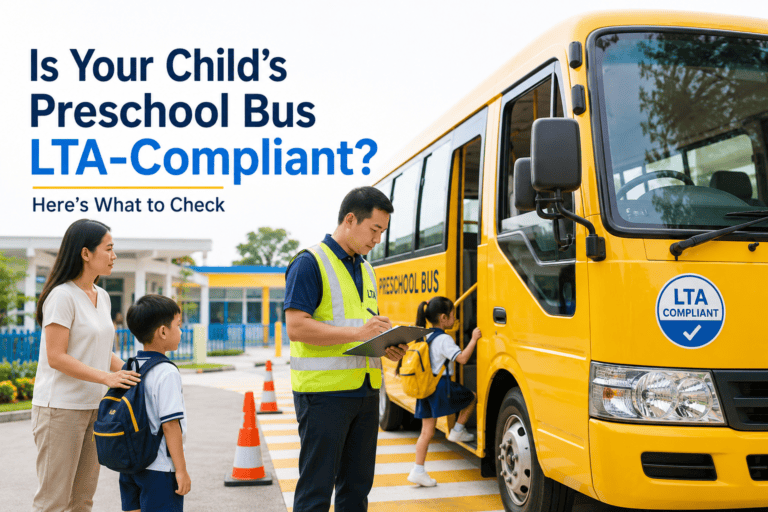
Most parents assume that if a bus is on the road picking up preschoolers, it must already meet whatever standard it’s supposed to meet. In practice, “licensed” covers a few different things, and it’s worth knowing what each one actually means before you hand your child over to a driver you’ve never met.
What Does LTA Compliance Actually Mean for a Preschool Bus?
The Land Transport Authority sets the rules that any commercial passenger vehicle in Singapore has to follow, and a preschool bus service falls squarely under those rules. That covers the vehicle itself, the insurance behind it, and the license held by the person driving it. None of these are optional extras a good provider adds on top. They’re the baseline, and the honest answer is that not every operator maintains all three equally well.
Is the Bus Itself Properly Registered and Insured?
A compliant vehicle needs full insurance covering both passengers and the bus, on top of regular mechanical checks that go beyond a yearly inspection sticker. Brakes, tyres, and air conditioning all get checked routinely, which matters more in Singapore than it might elsewhere, since a bus full of preschoolers on a hot, humid morning with a broken air conditioner is a genuinely bad start to the day.
It’s reasonable to ask a provider directly whether their insurance covers passengers specifically, not just the vehicle. It’s a simple question, and a provider that takes compliance seriously will usually answer it without hesitation.
Is the Driver Actually Licensed for Passenger Service?
Driving a car and driving a bus full of young children are two different responsibilities, and Singapore treats them that way. Drivers need a vocational license specific to passenger transport, not just a standard driving license, and that license needs to stay current through ongoing training rather than being a one-time box ticked years ago.
This is also where a preschool-specific service tends to differ from a general charter. A driver who regularly handles young children develops habits around seatbelts, headcounts, and calm handling of a crying three-year-old that don’t come up in the same way on a corporate shuttle or an airport transfer.
What Should You Actually Ask Before Booking?
It’s worth asking a provider whether their drivers hold a vocational license specifically, rather than just a regular one, and whether that training gets refreshed periodically rather than being treated as a one-off. It’s equally worth asking whether the insurance policy explicitly names passenger cover, since that detail is easy for a provider to gloss over if it isn’t asked directly. A provider who can answer both of these clearly and without hesitation is generally one who has actually built compliance into how they run the service, rather than treating it as paperwork to produce only if asked.
Does a Good Provider Do Anything Beyond the Legal Minimum?
Compliance is the floor, not the whole picture. LTA rules cover licensing, insurance, and vehicle upkeep, but they don’t dictate whether a driver does a physical headcount before pulling away from a stop, or whether an attendant is on board specifically to help small children with seatbelts and getting on and off safely. Those details sit above the legal minimum, and they’re usually the difference parents actually notice day to day.
It’s worth asking a provider whether an attendant rides along on preschool routes specifically, separate from the driver, and how they handle a child who isn’t at the pickup point when the bus arrives. Neither question has a single “correct” answer required by law, but the way a provider answers tends to say a lot about how seriously they treat the age group they’re transporting.
Why Does This Matter More for a Preschool Bus Than Other Charters?
An older child on a school bus can usually flag a problem, follow an instruction, or manage their own seatbelt. A preschooler generally can’t do any of that reliably, which is exactly why compliance checks that might feel like formalities for other charters become genuinely important here. A licensed driver who’s also used to working with very young children is a meaningfully different experience than a licensed driver who mostly isn’t.
That’s also why a dedicated preschool bus service typically runs with smaller groups and more hands-on supervision than a standard school bus charter, since the margin for error with a three-year-old is simply smaller.
So How Do You Know a Provider Takes This Seriously?
In practice, the easiest signal is longevity combined with a willingness to answer specific questions. A provider that’s been running preschool routes for years, rather than adding the service as an afterthought, has usually already worked through the compliance details rather than treating them as a checklist to pass once.
At RL Transport, that’s been the case for over 40 years, since the business began as Richard Leong Bus Charter Services before becoming what it is today. Every enquiry runs through the same straightforward process: you share your route, timing, and group size, we confirm the plan and brief the driver, the bus arrives on the day itself, and we follow up afterward to make sure everything actually went as planned. There’s nothing hidden in the middle of that, which is deliberate.
If you’d like to ask about insurance coverage, driver licensing, or anything else before booking, get in touch with our team directly, and we’ll answer plainly rather than pointing you back to general marketing copy.