
A conference bus plan for a one-day event in Singapore comes down to four decisions: how many delegates travel in each wave, which hotels the buses collect from and in what order, where the buses drop off and wait at the venue, and how people get back when sessions and the dinner finish at different times. Get those right and nobody notices the buses. Get them wrong and the first thing your delegates remember is standing in a hotel driveway at 7.50am wondering whether they have missed the bus.
This guide works through those decisions for a single conference day, using a worked example sized on real vehicles. If your event runs over several days, our piece on shuttle bus scheduling for multi-day events covers the extra issues that come with repeat days.
In short
- Size each wave by the number of delegates who must arrive by the same time, not by total registrations.
- Give each hotel its own pickup time and contact person. One bus can serve two nearby hotels; four is usually too many.
- Confirm with the venue where coaches set down and where they can wait, before you publish pickup times.
- Plan two return waves at least: one when sessions end, one after the dinner or networking event.
When a conference needs its own buses
Not every conference does. If delegates are local, the venue sits on an MRT line and the day ends in daylight, most people will make their own way. A conference bus earns its cost when one or more of these is true:
- Overseas delegates are staying in one or more hotels and do not know the city.
- The venue is away from the MRT, or the day includes a site visit or offsite dinner.
- The programme has a hard start, such as a keynote or a ministerial opening, and late arrivals would be noticed.
- The evening ends late, after a gala dinner or a reception, when taxis are hard to find in bulk.
Year-end conferences often combine all four. RL’s corporate event bus charter page suggests booking at least two to four weeks ahead, and earlier in peak periods such as year-end galas and major trade shows.
Counting delegates and sizing each conference bus wave
Start from your registration list, but do not plan around the total. Plan around the morning wave: the delegates who need to arrive before the first session. Remove people who live locally and have said they will travel on their own, speakers arriving separately, and staff who go early. What is left, split by hotel, is the number you size buses for.
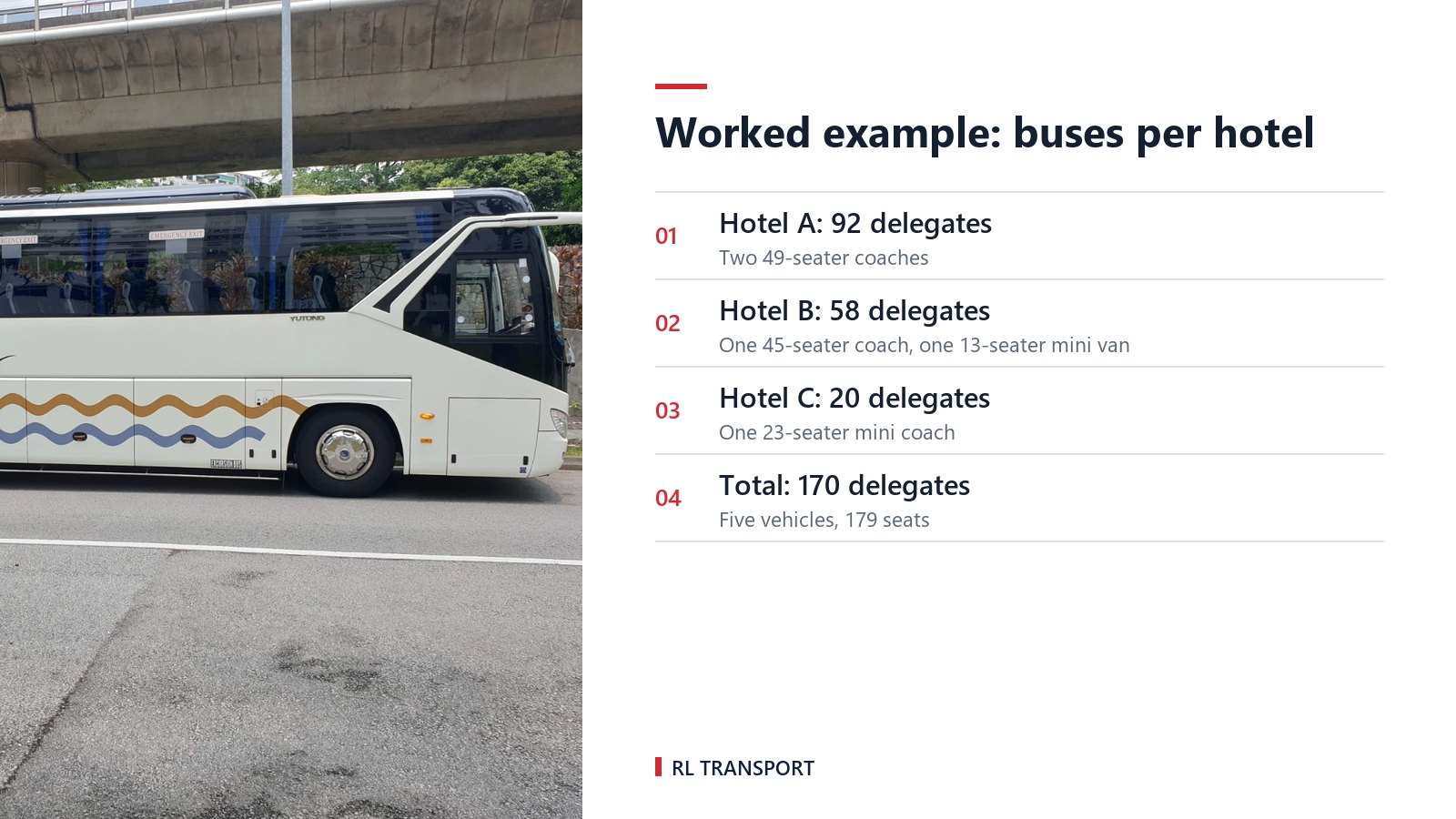
RL’s fleet has four sizes, each with a driver: a 13-seater mini van, a 23-seater mini coach, a 45-seater coach and a 49-seater luxury coach. Here is a worked example. The delegate numbers are invented for illustration; the vehicle sizes are RL’s.
| Hotel (example) | Delegates on the morning run | Vehicles | Seats |
|---|---|---|---|
| Hotel A (main block) | 92 | Two 49-seater coaches | 98 |
| Hotel B | 58 | One 45-seater coach and one 13-seater mini van | 58 |
| Hotel C | 20 | One 23-seater mini coach | 23 |
| Total | 170 | Five vehicles | 179 |
Notice Hotel B. Fifty-eight delegates in exactly 58 seats leaves no slack for a late registration or a laptop bag on a seat. In practice you would ask whether a few Hotel B delegates can ride with Hotel C, or move up a size. RL’s own advice on its 45-seater page is that when a headcount sits near the edge of a vehicle, the next size up usually costs less per head than squeezing everyone in.
Luggage matters on arrival and departure days. RL’s guidance is that a 49-seater takes around 38 passengers if everyone has a suitcase, and a 45-seater around 35. If delegates are checking out and heading to the airport after the closing session, size that trip on suitcases, not seats. For a general primer on matching vehicles to groups, see our bus and minibus capacity guide.
Pickups from more than one hotel
The cleanest plan gives each hotel its own vehicle and its own pickup time. When a hotel has too few delegates to justify a bus, it can share one with a nearby hotel, but set the order carefully:
- Collect from the smaller hotel first, so the bus arrives at the larger one with spare seats already accounted for.
- Allow time for each stop to load, not just the drive between them. A full coach does not board in two minutes.
- Name a delegate or staff member at each hotel who holds the list and tells the driver when everyone is on.
- Put the pickup point in writing: which entrance, which driveway, and whether the bus will be on the hotel’s own forecourt or a side road.
RL’s corporate event page notes it can plan routes across several pickup points, such as hotels around Orchard Road or offices in the CBD. If your hotels are spread across the island, though, separate buses are usually more reliable than one long loop.
Arriving at the venue: access and drop-off
Convention centres and hotel ballrooms each have their own rules for coaches: where they may set down, how long they may stay, and whether they need to be registered in advance. Do not assume. Ask the venue’s event team, in writing, three things:
- Where coaches drop off, and whether more than one can stop at a time.
- Whether coaches can wait on site, or must leave and return.
- Whether vehicle details need to be submitted before the day.
Then pass the answers to your bus operator. If five buses arrive within ten minutes at a drop-off bay that holds two, the last three will queue on the public road, and the delegates on them will walk into the keynote late. Staggering arrivals by five or ten minutes per bus avoids that.
Standby during the day or separate trips
Once delegates are at the venue, you have two choices for the buses: keep them on standby, or release them and book them back for the return.
| Standby all day | Separate morning and evening trips | |
|---|---|---|
| Best when | There is a site visit, an offsite lunch, or the finish time is uncertain | Delegates stay at the venue all day and the finish time is fixed |
| How time is counted | Bus and driver are with you for the whole block, including waiting | Two shorter bookings |
| Flexibility on the day | High: the bus is already there | Lower: changes depend on the operator’s availability |
| Venue waiting space | Needed, or a nearby place to hold the bus | Not needed |
RL’s fleet pages list hours booked, distance, pickup points and date as the factors in a quote, with waiting time between legs counted in the hours. Ask for both options to be priced. For a one-day event with a midday site visit, standby is usually the only workable answer.
Staggered returns after sessions and the dinner
Arrivals are easy because everyone has the same deadline. Returns are harder, because people leave at different times. Plan at least two waves:
- After the last session. Some delegates want to go back to change before dinner, or skip dinner altogether. A smaller vehicle may be enough for this wave.
- After the dinner or networking event. This is usually the larger wave, and the one most likely to run late. Tell the operator the expected finish and the latest possible finish, so drivers can plan around both.
If the dinner is at a different venue from the conference, that is a third movement: conference to dinner venue, usually as one large wave. Make sure the dinner venue’s coach access has been checked the same way as the main venue’s.
For December events, also check road closures near your hotels. On Thursday 24 December 2026, the Christmas Eve street party on Orchard Road closes part of the road from Paterson Junction (ION Orchard) to Bideford Junction (Ngee Ann City) from 6pm to 2am, according to the organisers (checked 16 November 2026). On the day itself, LTA’s traffic cameras on OneMotoring give a quick look at traffic at key points before you confirm departure times.
Telling delegates where and when to board
Delegates who miss the bus usually did not know where it would be. Put the details in three places: the joining instructions sent before the event, a printed notice at each hotel’s concierge or lobby, and the event app or chat group if you have one. Each notice should give:
- The pickup time and the departure time (they are not the same).
- The exact boarding point, with a landmark.
- The return times for each wave and where to board at the venue.
- A number to call if they are running late.
On the morning, have someone from your team at each hotel pickup with the list. The driver will wait as agreed, but the decision to leave should rest with that person.
What to send your conference bus operator
Two weeks out, send a single document with: the date, each hotel and its boarding point, the delegate count per hotel, arrival deadline at the venue, the venue’s coach rules, the return waves with expected and latest finish times, luggage on arrival or departure days, and one contact per hotel plus an overall coordinator. Update it as registrations change.
RL Transport has moved groups in Singapore for more than 40 years, and every booking comes with a driver and a company-owned vehicle. If you have a conference date and a rough headcount, the 49-seater luxury coach page shows the largest vehicle in the fleet, and the contact page is the quickest way to ask for a written quote.
Frequently asked questions
How many delegates fit on one bus?
RL’s largest vehicle is a 49-seater luxury coach, and it also runs a 45-seater coach, a 23-seater mini coach and a 13-seater mini van. With light bags, every seat can be used. If each delegate has a suitcase, RL’s guidance is around 38 on the 49-seater and around 35 on the 45-seater.
Should the bus wait at the venue all day?
Only if you need it during the day, for a site visit or an offsite lunch, or if your finish time is uncertain. Otherwise separate morning and evening trips are often simpler. Check first whether the venue allows coaches to wait on site.
How far ahead should we book conference buses in December?
RL suggests booking corporate event transport at least two to four weeks ahead, and earlier in peak periods such as year-end galas. December is one of those periods, so book as soon as the date and venue are confirmed.
Can one bus serve several hotels?
Yes, if the hotels are close together and the combined headcount fits. Collect from the smaller hotel first, allow loading time at each stop, and give each hotel its own pickup time. Hotels far apart are better served by separate buses.
What if the gala dinner ends late?
Tell the operator both the expected and the latest possible finish when you book. Agree in writing how extra time will be charged and who on your team can approve it on the night. That way the buses are there when the dinner ends, whenever that is.